

A rich man once invited a beggar to share his meal.
The host settled quietly into his seat and tucked his linen napkin beneath his chin. The guest, finding himself supported by silken cushions instead of the usual hard bench, sighed in surprised pleasure; with much creaking and squeaking he burrowed into the chair, determined to savor its opulence to the utmost.
The soup arrived and proceeded to make its casual way down the rich man’s gullet. Across the table, a frontal attack was being launched against the delicate china bowl; the heavy silver spoon clanged and swooped, carrying every precious drop of steaming gold to an audibly eager mouth. The subsequent assault on the steak platter was no less enthused. As the wealthy man silently ingested bite-sized pieces of meat, his dinner partner, a maelstrom of clattering knives and chomping jaws, oohed and aahed his delighted way through the feast.
In the kitchen, the cook remarked to the butler: “At last, a man who appreciates fine cuisine! The master may be indifferent to the finer things in life, but his guest! What passion! How involved he is, how worshipful of quality. Now, here is a man with a sense of the sublime . . .”
“You are mistaken,” countered the butler. “The very opposite is true. The rich man’s tranquility indicates the depth of his involvement with his dinner, while the pauper’s noisy excitement only underscores how alien all this is to him. To the rich man, luxury is the very essence of life; so he no more exclaims over it than you jump for joy upon finding yourself alive in the morning. But for the poor man, life is a boiled potato, and this is an otherworldly experience. All that noise you hear is the friction between his habitual self and the luxuriating self he is attempting to assume.”
The Hem
Noise is the mark of resistance. Consider the sounds emitted by a log fire, a pile of burning straw and an oil lamp. In each case, matter is succumbing to the energy locked within it. The log offers the most resistance, voicing its reluctance to part from its outer form with a noisy crackle and sudden explosions. The straw, not quite as physical as the log, protests with a whispering sizzle. And the oil in the lamp, the finest substance of the three, burns silently, freely yielding to the essence within.
Thus, Elijah the Prophet experienced G‑d’s immanence as “a still, small voice.” In his refined self, the material of the body did not resist the spirituality of the soul. Thus, he perceived the divine reality not in a norm-shattering storm, but in the same tranquil manner in which a person is aware of the life within him.
And yet, Aaron the kohen gadol (high priest), the epitome of refinement and spirituality, is commanded to wear a robe with bells sewn onto its hem, so that “its sound shall be heard when he enters into the holy area before G‑d.” For the kohen gadol represents the entirety of Israel in his service of the Almighty, including those for whom connection to G‑d is still a noisy struggle—the struggle to transcend their external, earthbound selves and bring to light their true, inner identity.
Rabbi Israel Baal Shem Tov was once asked: Why do some of your disciples make such a ruckus while praying? They shout, they wave their arms, they virtually throw themselves about the room. Is this the appropriate way to commune with the Almighty?
The founder of Chassidism replied: Have you ever seen a drowning man? He shouts, he thrashes his arms, he struggles with the waves that threaten to claim him. Throughout the day, a person is swamped by the demands of his material existence; prayer is the attempt to break free of the engulfing waters that threaten to extinguish his spiritual life.
True, a noisy service of G‑d is an indication that the person has not yet fully “arrived.” Had he succeeded in transcending the mundane, his endeavor to draw close to the Almighty would be a tranquil one—his soul would strive upwards with a silent, frictionless flame. His tumultuous struggle reflects the fact that his spiritual self has not yet become the seat of his identity—that his “natural” self still lies with the material externalities of life. Nevertheless, this is a healthy sign: he has not succumbed. He is straining to free himself of the confining envelope of his material being, straining to rise above his presently defined self.
So the bells on the hem of the kohen gadol’s robe are an indispensable part of his divine service. “Its sound shall be heard when he enters into the holy area before G‑d,” commands the Torah, “lest he die.” Were he to disclaim the lowly “hem” of the nation he represents, he would be violating the very essence of his mission. Were his service of the Almighty not to embody the struggles of his imperfect brethren, it would have no place in G‑d’s inner sanctum.
Apples and Pomegranates
In light of the above, we can understand the deeper significance of the debate between two of our sages regarding the bells and pomegranates on the kohen gadol’s robe.
The debate addresses the question of how to interpret the word b’tocham, which translates either as “between them” or, in a more literal rendering, “within them.” Does the Torah command to “make upon its hem pomegranates . . . and bells of gold between them,” or to affix the “bells of gold within them”?
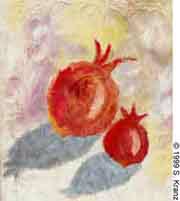
Rashi, in his commentary on this verse, maintains that the bells were “between them . . . Between each two pomegranates, a bell was attached and hanging on the hem of the robe.” Nachmanides disagrees. “I don’t know why the master [Rashi] made the bells separate, a bell between two pomegranates,” he writes. “According to this, the pomegranates served no function. And if they were there for beauty, then why were they made as hollow pomegranates? They should have been made as golden apples . . . Rather, [the bells] were literally within them, for the pomegranates were hollow—like small, unopened pomegranates—and the bells were contained within them . . .”
The later commentaries enter into the debate. “Why does [Nachmanides] favor apples over pomegranates?” wonders Rabbi Elijah Mizrachi. Other commentaries explain that Nachmanides’ difficulty with Rashi’s interpretation is that the hollow form of the pomegranate (Rashi himself also says that they were “round and hollow”) indicates that they served a functional rather than a decorative purpose. But what does Nachmanides mean when he says that “if they were there for beauty . . . they should have been made as golden apples”?
Indeed, the menorah was decorated with spheres resembling apples, whose sole purpose was for beauty. Perhaps Nachmanides derives from this that in the making of the Sanctuary and its accessories, the decorative fruit of choice was the apple. But this itself requires explanation. Why apples? And why, according to Rashi, was the menorah beautified with apples, and the kohen gadol’s robe with pomegranates?
Insulated Deeds
Both the apple and the pomegranate are representative of the Jewish people. The Torah likens Israel to an apple (“Like an apple among the trees of the wood, so is my beloved”—Song of Songs 2:2) as well as to a pomegranate (“Your lips are like a thread of scarlet, and your mouth is comely; your temple is like a piece of pomegranate within your locks”—ibid. 4:3). But while the apple represents Israel in a virtuous state, the pomegranate refers to the “hollow” or “empty ones amongst you.” As interpreted by the Talmud, the verse “your temple is like a piece of pomegranate” comes to say that “even the empty ones amongst you are full of good deeds as a pomegranate [is full of seeds].” (Rakah, the Hebrew word used by the verse for “temple,” is related to the word reik, “empty.” Thus, “your temple” is homiletically rendered “the empty ones amongst you.”)
The pomegranate is more than a model of something that contains many particulars. On a deeper level, this metaphor also addresses the paradox of how an individual may be “empty” and, at the same time, be “full of good deeds as a pomegranate.”
The pomegranate is a highly “compartmentalized” fruit. Each of its hundreds of seeds is wrapped in its own sac of flesh, and is separated from its fellows by a tough membrane. In the same way, it is possible for a person to do good deeds—many good deeds—and yet they remain isolated acts, with little or no effect on his nature and character. So, unlike the “apple,” whose deliciousness is from core to skin, the “pomegranate” contains many virtues, but they do not become him. He may be full of good deeds, yet he remains morally and spiritually hollow.
This explains the connection between the pomegranates and the bells on the hem of the priestly robe. As explained above, the noisy bells represent the imperfect individual who is striving to transcend his deficient state. Although he is still a spiritual pauper, he refuses to act like one—hence the noisy friction that characterizes his life.
Beautiful Noise
To become an apple, one must first be a pomegranate. One must act unlike himself, like a poor man feasting at a rich man’s table: a clumsy spectacle, perhaps, but an inevitable one if a person is to transcend the animalistic, egocentric self into which every man is born. The first step to becoming perfect is to behave as if perfect. Indeed, before Elijah experienced G‑d in a “still, small voice,” he first beheld the wind, the storm and the fire.
Thus, Nachmanides sees the pomegranate-encased bells on Aaron’s hem as a preliminary phase of one’s divine service, rather than as the service itself. Beauty, however, is to be found in the “apple” perfection of the menorah: seven lamps of pure olive oil, representing the soul’s silent, tranquil flame. If the pomegranates on the priestly robe were for beauty, argues Nachmanides, they would not be pomegranates, but apples. These hollow fruits are purely functional, a preparatory stage in the soul’s quest for perfection and union with her source in G‑d.
According to Rashi, however, the beauty of Israel lies also in its “pomegranates.” In fact, in a certain sense, the struggle of the imperfect soul is even more beautiful than the serene perfection of her more virtuous fellow. For the perfectly righteous individual serves G‑d by being what he is, while every positive deed of the “empty ones amongst you” is an act of sacrifice and self-transcendence. So even before a person attains perfection—even if his entire life is spent in the quest for perfection—the clamor of his efforts is music to G‑d’s ear.
A Contemporary Application
There are those who claim that the Torah and its mitzvot are a private matter between the Jew and his G‑d, not something to be paraded in the streets. Tefillin, Shabbat, the sanctity of family life, “esoteric” concepts such as “divine reality” or “Moshiach,” are not to be hawked on a downtown sidewalk or catchphrased on a slick billboard. Never, in our history as a nation, has anything like this been done, they say. You are vulgarizing the soul of Judaism, they accuse.
But this is the “hem” of history, the lowliest and most superficial generation yet. To this generation, the still, small voice of G‑d sounds like alien noise. Should this voice be hushed, to be whispered only among the apples? Or should its call be sounded, noisy though it be, until it is heard above the din?
Speaking to this generation in its own language—the language of the soundbite, of incessant compartmentalization and hollow packaging—ever further raises the noise level. But fighting fire with fire is not only effective; it also brings to light facets of one’s own potential that would otherwise remain unrealized. The bells and pomegranates that broadcast the divine truth are more than the means toward a tranquil end; they are themselves things of beauty.



Join the Discussion